
In modern manufacturing, the metalworking equipment is rather important -press brakes. They find their applications in such diverse fields as automotive, aerospace, and even construction. With all the advancements in technology, press brakes have evolved from manually operated ones to numerically controlled (NC) and later to computer numerically controlled. High precision, high efficiency, and degree of automation make the CNC press brake he indispensable tool for today’s metalworkers. This brings us to the bone of contention: what really sets apart traditional press brakes from CNC press brake machines? There shall be a good analysis that follows.
I. Press Brakes VS CNC Press Brake Machines
A traditional press brake is defined as a machine that forms metal sheets using either mechanical or hydraulic means. It clamps the workpiece firmly between the molds and applies pressure to perform the bending process. Manual adjustment dominates the operation of a conventional press brake, in which adjustments for die installation, control over the bending angle, and positioning of the workpiece have to be made manually. Though this mode of operation is simple and direct, it requires much expertise from the operator. Besides, productivity and precision are comparatively lower.
In contrast, Máquina plegadora CNC uses advanced computer numerical control technology. It uses a computer system to precisely control the bending process, including die selection, bending angle, bending sequence, and workpiece positioning. The CNC system can automatically complete complex bending tasks according to a pre-programmed sequence, greatly improving production efficiency and processing accuracy. In addition, CNC press brake machines can also perform simulated bending through software to identify potential problems in advance and reduce trial-and-error costs.
II. Advantages of CNC press brake machines
1. High precision and high efficiency
The core advantages of CNC press brakes lie in their high precision and high efficiency. The bending accuracy of traditional press brakes is usually around ±0.5 mm, while the accuracy of CNC press brakes can reach ±0.01 mm. This high-precision processing capability enables CNC press brakes to meet the demanding accuracy requirements of high-end manufacturing industries such as aerospace and precision instruments.
2. Flexibility and adaptability
The flexibility and adaptability of CNC-controlled press brakes are also unmatched by traditional press brakes. Traditional press brakes require a lot of manual operation when changing moulds or adjusting bending angles, which is not only time-consuming but also prone to errors. CNC press brake machines, on the other hand, can quickly switch between different processing tasks through simple program adjustments. This flexibility enables CNC-controlled press brakes to easily cope with small-batch, multi-variety production demands, greatly improving equipment utilisation and enterprise market competitiveness.
Using a traditional press brake takes a lot of time because you have to adjust the mold and settings for each new task. This is slow and can lead to mistakes. But with a CNC-controlled press brake, you just change the program on the computer. This is much faster and makes fewer errors. It keeps the quality of the products stable and makes the machine work better.
3. Reducing labour costs and improving safety
Due to the high degree of automation of CNC press brake machines, operators are only responsible for loading and unloading workpieces, greatly reducing the reliance on skilled workers. The operation of traditional press brakes requires skilled technical workers, who need to undergo long-term training to master the operating skills. The operation of CNC press brakes is relatively simple. Through an intuitive user interface and automated control, ordinary workers can get started after a short period of training, significantly reducing labour costs.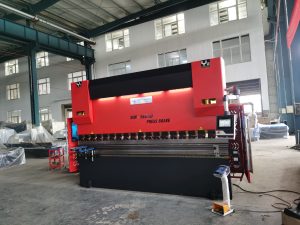
Also, CNC press brake machines are safer. Automation decreases the probability of manual contact with dangerous parts, plus the equipment comes with a series of safety protection devices that can effectively prevent any accident during operation. For instance, CNC-controlled press brakes normally come equipped with emergency stop buttons, a light curtain protection device, and automatic protective covers. These can sense abnormal conditions within time during operation and immediately stop the machine to ensure operator safety is not compromised. Such high safety not only safeguards workers’ personal safety but also keeps production from being interrupted, hence accidents causing economic losses.
Ⅲ. Future development trends of CNC press brake machines
Technology keeps upgrading, so does the CNC Controlled Press Brake keep changing and improving. The future CNC press brake will come out much smarter, more automatic, and faster. For instance, there is already an automatic mold change function available in some high-end CNC controlled press brakes that can perform mold changes within a very short period; hence, production efficiency goes even higher. Plus, with the help of Artificial Intelligence and Internet of Things technologies, CNC controlled press brakes in the future will carry features like remote monitoring, fault diagnostics, plus predictive maintenance.
Ⅳ. Conclusion
The CNC press brake has now become an integral part of modern metal processing. It offers precision, efficiency, flexibility, and automation. In comparison with traditional types of press brakes, this type increases the production efficiency and accuracy of products, lowers labor costs, and enhances safety. With the technology trend on a continuous rise, such machines improve and bring greater innovation into the metal processing industry. If you are looking for production efficiency and product quality, choosing a professional CNC press brake machine manufacturer is the ideal choice.